Case Study: From Prototype to Reality
From Prototype to Reality
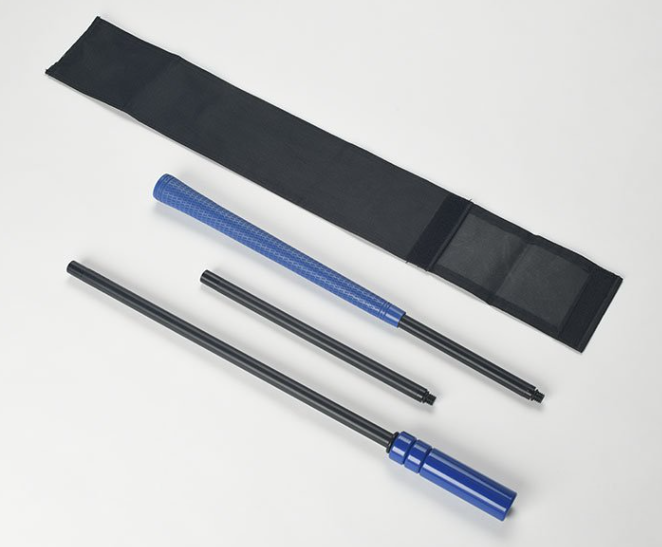
Steve Bergeron came to us with a new idea for a golf swing training aid, The Swing Sim. Versatile and adjustable – something you could use anywhere. He had a prototype version in hand already, pieced together from off-the-shelf components and a few parts he machined himself in his garage.
It was a great concept. We worked with him to refine it and built a more production ready prototype that looked the part and performed the way it was intended. In-house testing checked out. The swing felt right. The feedback was there. Proper lag. From a development standpoint, it was ready for the next step.
So Steve sent it into the field.
Where Things Broke Down
It didn’t take long for the first issue to surface. The first users were breaking the interconnect piece. They were using it harder, more aggressively, and in ways that weren’t fully accounted for during Steve’s initial testing.
Our first response was material-driven. We upgraded the interconnect from 6061 to 7075 aluminum, gaining strength and better fatigue resistance. That change solved the immediate problem. Failures stopped, and the product held up under continued use.
Then the design evolved again.

The Ripple Effect of Small Changes
To improve swing feedback, the Steve had changed the upper handle from plastic to aluminum. On paper it made sense, but soon the interconnect pieces started breaking again.
Steve brought some inventory back for us to review. We went outside and swung them all around. Sure enough, after repeated use, they’d snap.
We all sat down and scratched our heads. What really changed aside from a material change? We came to the conclusion that the behavior of the swing completely changed. With the entire shaft as plastic, the energy was distributed evenly and each interconnect piece took on a relatively even load. When the top handle was changed to aluminum, the energy overloaded the first interconnect causing it to snap upon use.
Solving the Right Problem
At that point, it wasn’t just about increasing strength. It was about managing fatigue under repeated, real-world loading conditions.
We stepped back and looked at material performance more closely, specifically focusing on fatigue resistance rather than just static strength. That led us to 12L14 steel. Stronger than aluminum, but soft enough to properly absorb the redistributed energy without fatiguing.
We made some prototypes, and the interconnect held up under actual use. The failures stopped, and the product performed reliably in the field.
Lesson Learned
Real users introduce variables you won’t see in a controlled environment—more force, different handling, repeated abuse. And every design change, even ones that seem minor, can shift how stress moves through a product.
If you’re not testing in the field, you’re not testing the real product.